

Tree Removal in Frisco, TX
When a Frisco tree was the wrong pick for the spot, we take it out cleanly and help you plan what goes in next.
- ISA CertifiedArborist #TX-4334A (opens in a new tab)
- Fully InsuredProof on Request
- Written QuoteBefore Work Starts
- Cleaner ThanWe Found It
Frisco trees we’re asked to remove
In newer yards, removals are rarely about a giant old tree. More often it’s a younger tree that isn’t working out. These come up a lot:
- Bradford pears that are splitting apart
- Trees planted too close to the foundation
- Young trees that died after a hot, dry summer
- Trees with a weak fork that already cracked
- Trees badly broken in a spring storm

“From the time I originally contacted them for a quote to the job completion was super fast. Their work fabulous and I’m very happy with the outcome.”
Clifton G., Google review
Most Frisco removals are assessed by Taylor Guynes, an independent ISA Certified Arborist #TX-4334A (opens in a new tab). Meet Taylor.
The Eagle Tree Way
1
Check if it can stay
Some trees just need good pruning. We’ll tell you.
2
Price it in writing
Removal, stump and cleanup listed separately.
3
Take it down safely
Cut in sections near the house, fence or sidewalk.
4
Clear the spot
Debris gone, ready for grinding or for you to replant.
Included in every Frisco removal
- A straight answer on whether the tree can be saved
- Written quote before work starts
- Insured crew, certificate on request
- Care for sod, beds and sprinkler heads
- Wood and debris hauled off
Related services


Removing the wrong tree so the right one can grow
Bradford pears (opens in a new tab) were planted all over North Texas for years. They grow fast and flower nicely, then they tend to split as they get bigger because so many limbs grow from the same spot on the trunk. If yours has already lost a big limb, the rest usually isn’t far behind. Taking it out before it breaks across the driveway is the easier way to deal with it.
The other common Frisco removal is a tree that’s simply in the wrong place. A shade tree four feet from the foundation will be a problem for the roof and maybe the slab as it grows. Moving it isn’t usually practical, so removal and a better-placed replacement is often the fix. We can grind the stump so the spot is ready, and a nursery or landscaper can help you put a new tree somewhere it has room to grow.
Not every struggling tree needs to go. A young tree with a few dead branches after a rough summer can sometimes recover with pruning and better watering. Before we quote a removal, we look at whether the tree can be saved and tell you honestly. If it can’t, you get the reason and the price in writing.
Removing trees in a fast-growing Frisco
Frisco straddles Collin and Denton counties, and much of the city was built quickly. Lots of yards got their trees right as the house was finished, often a few quick-growing picks set in small planting strips. Fifteen or twenty years on, some of those trees have outgrown the space they were given, and that’s when removal calls start.
Construction also left its mark below ground. Heavy equipment packs clay soil hard, and topsoil is often thin over that layer. Roots stay shallow, water runs off instead of soaking in, and a tree can look fine for years before a dry summer or a strong spring wind shows how weak its footing is. When we assess a Frisco tree for removal, we look at the soil and root area as closely as the canopy.
Our office is in Plano, a short drive up the Dallas North Tollway, so getting a crew and equipment to Frisco is routine. Newer lots often have tight side yards and shared fences, and we plan the cuts and the path out of the yard around that before anyone starts a saw.
Save it or take it down?
This is the first question we answer on every removal visit. A tree with problems isn’t automatically a tree that has to go. Here’s roughly how we sort it out:
Usually worth saving
- Most of the canopy leafs out normally each spring
- Damage is limited to a few limbs that can be pruned back
- The trunk is solid, with no deep cracks or soft spots
- The species holds up well in North Texas heat and clay
- It has room to grow without crowding the house
Usually time to remove
- The trunk or main fork has split open
- More than half the crown is dead or bare
- It’s a Bradford pear that has started shedding big limbs
- Roots are lifting, or the tree began to lean after a storm
- It sits so close to the house that every year makes it worse
What affects the price of tree removal in Frisco
We don’t quote a removal until we’ve seen the tree, because two trees of the same height can be very different jobs. These are the things that move the number:
- Size and spread. A taller tree with wide limbs means more cutting, more rigging and more wood to haul.
- What’s underneath. A tree over a roof, pool or fence has to come down in small, roped pieces instead of being dropped whole.
- Access to the yard. Narrow side gates and backyards with no alley access mean more carrying by hand and more time.
- Condition of the wood. Split, dead or storm-broken trees can be unpredictable to cut, so the crew works slower and more carefully.
- Stump and cleanup choices. Grinding the stump, removing the chips and hauling all the wood are listed as separate items so you can choose.
- Number of trees. Removing two or three trees in one trip usually costs less overall than separate visits.
Every removal comes with a written quote that spells out what we’ll do. The price on the quote is the price you pay, with no surprise charges added at the end of the day.
What to expect on removal day
- Walk the site. The crew lead checks the quote, marks the drop zone and notes sprinkler heads, beds and anything fragile.
- Protect the yard. Mats or plywood go down where equipment crosses the lawn, and heavy gear stays off the driveway edges.
- Take it down in sections. Limbs come off first, then the trunk in manageable pieces, lowered by rope where there’s no room to drop.
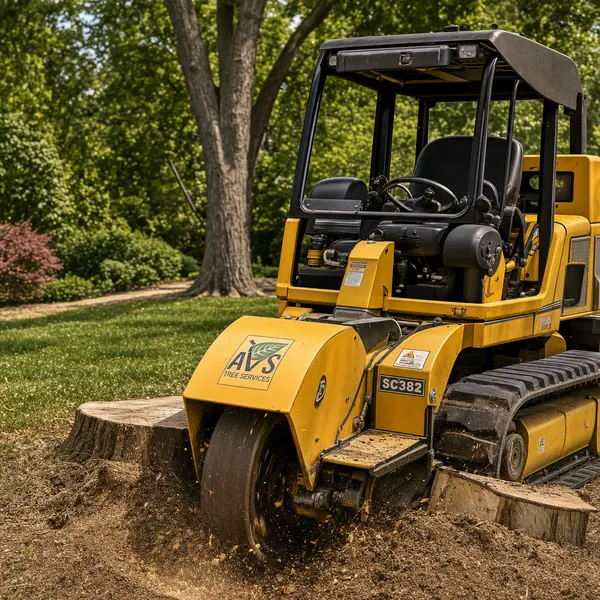
- Grind the stump if you chose it. The grinder takes the stump below grade so the spot can be filled, sodded or replanted.
- Clean up and walk it again. We rake, blow off hard surfaces and haul the wood, then walk the yard with you before we leave.
How to get ready
- Move cars out of the driveway and off the street in front of the tree
- Unlock side gates and let us know about pets
- Clear patio furniture, grills and planters from the work area
- Flag any sprinkler heads, lighting or buried pet fence lines you know about
- If approval is needed, check with your city or HOA before the date
Frisco tree removal questions
Should I remove my Bradford pear before it breaks?
If it has already split or lost a major limb, removal is usually the safest choice. If it’s still whole, we can look at its structure and tell you how much risk it carries over the house, drive or sidewalk.
Can a new tree go where the old one was?
Often, after the stump is ground and the spot is prepared. Sometimes a few feet over is better, especially if the old tree was too close to the house. We don’t plant trees, but a local nursery or landscaper can help you pick one that suits the space.
My young tree looks dead. Is it too late?
Not always. Scratch a small twig with your thumbnail. Green underneath is a good sign. Either way, we can take a look and tell you whether it’s worth saving or time to replace.
Does my HOA need to approve a removal?
Many HOAs have rules about removing or replacing trees, so check with yours first. If you need a written quote for the approval process, we’re glad to provide one.
How long does a typical Frisco tree removal take?
Most single-tree removals in a home yard are finished in a day, often less. Large trees over the house, or several trees at once, can take longer. Your quote will tell you what to plan for.
Will removing a tree damage my lawn?
We work to keep it minimal. Mats protect the turf where equipment rolls, and pieces are lowered instead of dropped near beds. Some flattened grass is normal and usually recovers in a few weeks.
Why did my tree die even though I watered it?
In newer yards, compacted clay is often the cause. Water sits on top or runs off, and roots can’t spread or breathe. Watering helps, but it can’t fix a root zone that was packed hard during building.
Can you remove just part of a tree?
Yes, if the rest of the tree is sound. Taking out one damaged limb or one side of a split can sometimes buy a tree years. If what’s left would be unstable, we’ll say so and explain why full removal is the safer call.