
Tree Service in Richardson, TX
Arborist-led care for Richardson’s big, older trees. Keep what can be kept, remove what can’t, and put the price in writing first.
- ISA CertifiedArborist #TX-4334A (opens in a new tab)
- Fully InsuredProof on Request
- Written QuoteBefore Work Starts
- Cleaner ThanWe Found It
Tree work we do in Richardson
Richardson has a lot of established neighborhoods, and the trees there have had decades to get big. That changes the kind of work they need:
- Deadwood removal from large, older canopies
- Cabling and bracing for heavy limbs or weak forks
- Crown reduction to ease weight over the house
- Large tree removal in tight, mature yards
- Storm damage cleanup after spring storms

“They get the job done quickly, clean up any mess and their pricing is fair.”
Christine B., Google review
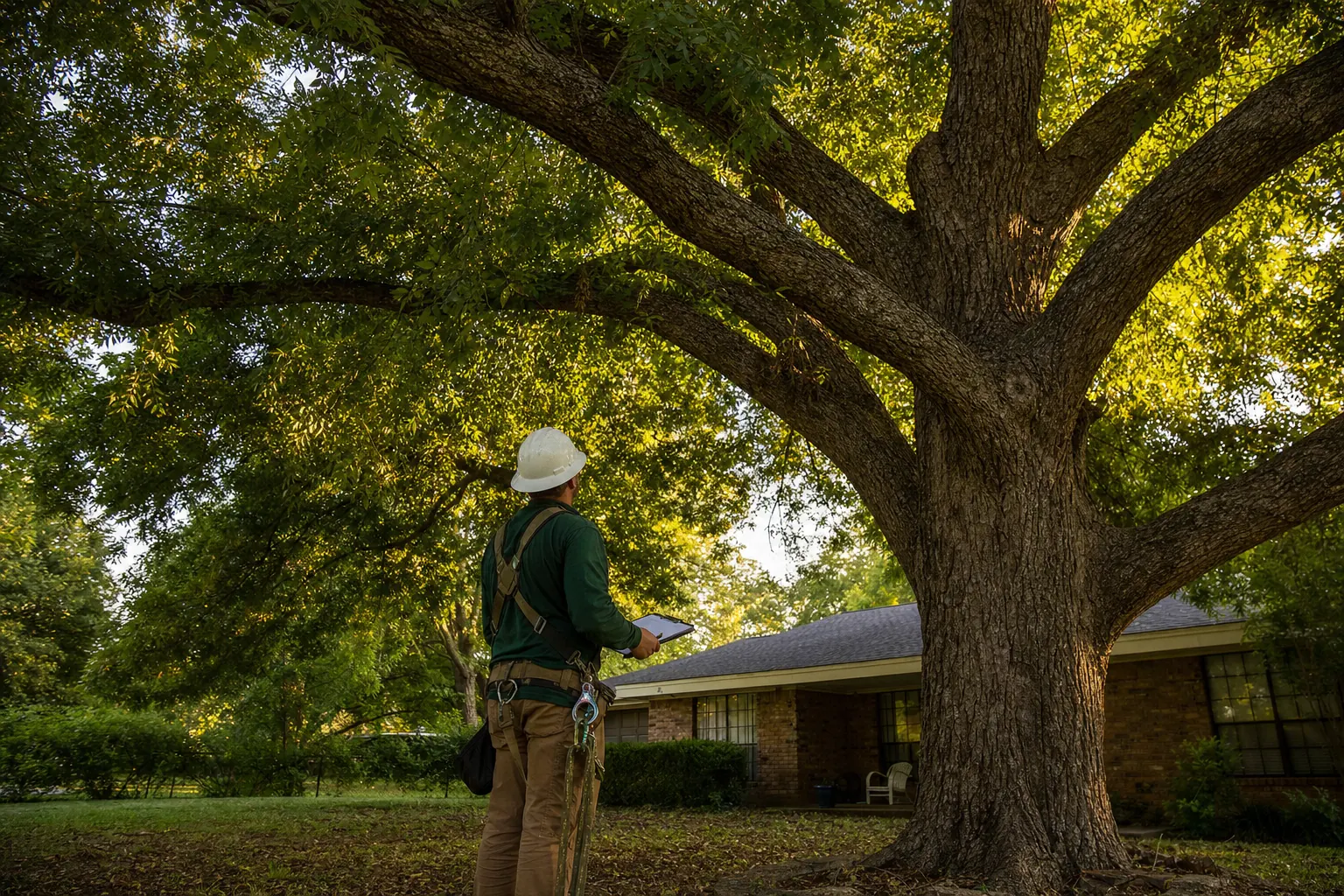
Most Richardson jobs are assessed by Taylor Guynes, an independent ISA Certified Arborist #TX-4334A (opens in a new tab) and ISA TRAQ qualified for tree risk assessment. Meet Taylor.
The Eagle Tree Way
1
Assess the risk
We check the trunk, the forks and the heavy limbs.
2
Lay out the options
Prune, support or remove, and why, in writing.
3
Work with care
Big limbs roped down, never dropped on the roof.
4
Finish clean
Wood hauled off, yard raked and blown.
Every Richardson job includes
- Arborist look at older, larger trees
- Written quote before any work
- Rigging to protect the house, fence and lawn
- Insured crew, certificate on request
- Cleanup and haul-off


Tree services in Richardson

Tree Removal in Richardson, TX
Tree removal in Richardson, TX for big, mature trees in tight, established yards. Sectional rigging, insured crew, written quote first. Call (214)…
Read more
Tree Trimming in Richardson, TX
Tree trimming in Richardson, TX for mature oaks, pecans and elms: deadwood, weight reduction and clearance, never topping. Written quote. Call (214)…
Read moreCaring for Richardson’s mature trees
A big old pecan or red oak is one of the best things a house can have. It shades the roof, cools the yard and you can’t buy one off a lot. It also carries a lot of weight over the things you care about. As trees age they collect dead limbs, develop heavy leaders and sometimes grow forks that weaken over time. Catching those things early is how you keep the tree for another twenty years.
That’s where an arborist’s eye matters. Taylor spent years as a city arborist and urban forester in North Texas, and he’s TRAQ qualified to assess tree risk. When he looks at a mature tree, he’s asking what it needs to stay safe: some deadwood out, a cable between two leaders, a reduction to take weight off a long limb. Removal is on the list only when it’s the safer call.
When a big tree does have to come down in an older yard, space is usually tight. Fences, garages, neighbors and lines are close. We take those trees down in sections and lower each piece with ropes, so nothing lands where it shouldn’t. Our crew is based in nearby Plano, and we finish every Richardson job the same way: wood gone, yard clean.
Why Richardson trees need a different approach
Richardson sits in both Dallas and Collin counties, right on Plano’s southern edge. It’s one of the older suburbs in the area, and you can tell by the trees. Many neighborhoods have had decades for their pecans, red oaks, live oaks and cedar elms to grow into wide, heavy canopies that shade the whole street.
Age brings its own set of problems. Older trees carry more dead limbs, more weight at the ends of long branches and more forks that were small once and are now holding up tons of wood. Pecans in particular are known for dropping limbs, and big trees growing in North Texas clay go through years of wet springs and dry, cracking summers. Over time that stress shows up as dieback, decay and weak spots you can’t always see from the ground.
Lots in established neighborhoods also tend to be tighter around the tree than people expect. Garages, fences, pools and additions have gone in over the years, often right under the canopy. That’s why so much of our Richardson work is careful rigging and risk assessment, not just cutting. It’s a quick trip down from our office in Plano, so we’re in Richardson often.
Keep the old tree or take it down?
Nobody wants to lose a tree that’s been shading the house for decades. Most of the time we can keep it. Here’s how we think through the hard cases:
Signs it can stay
- Solid trunk with no major cavities or cracks
- Deadwood is scattered, not most of the crown
- A weak fork that a cable and brace can support
- Long, heavy limbs that a reduction can lighten
- Healthy leaf-out across most of the canopy
Signs it may need to go
- Large decay or hollow sections in the trunk or root flare
- A crack running through a main fork
- Major dieback over much of the crown
- A new lean, or soil heaving at the base
- Repeated large limb failures over the house
What affects the price of work on mature trees
Big, older trees in tight yards take more planning and more skill than young trees on open lawns. These are the things that drive the cost in Richardson:
- Tree size. Height, trunk size and canopy spread set how much wood there is to cut, lower and haul.
- What’s underneath. Roofs, pools, fences and power lines mean more pieces, more rigging and slower work.
- Condition. Decayed or cracked wood has to be handled with extra care, which takes time and the right gear.
- Type of work. Deadwood removal, cabling, reduction and full removal each take different time and equipment.
- Access. A backyard tree with no room for equipment may need to be climbed and carried out by hand.
- Stump and cleanup. Grinding the stump of a large tree and hauling off heavy wood both add to the scope.
After the walk-through you get a written quote that lays out the options, such as pruning, support or removal, with each one priced. You choose. No surprise charges show up later.
What to expect when we work on a big tree
- Safety briefing. The crew lead reviews the plan, the drop zones and anything we need to protect.
- Rigging set. Ropes and lowering gear go up so heavy pieces come down slow and controlled.
- Work in sections. Limbs or trunk sections are cut in sizes the rigging can handle, then lowered to the ground.
- Support if planned. Cables or braces are installed high in the tree where they can share the load.
- Clean finish. Wood is hauled off, the yard is raked and blown, and we walk it with you.
How to get ready
- Move cars, grills and outdoor furniture away from the tree
- Unlock gates and make sure we can get to the backyard
- Let neighbors know if limbs hang over their yard
- Keep kids and pets inside while we work
- Tell us about sprinklers, lighting or buried lines you know of
Richardson tree service questions
My big tree looks fine. Why would it need work?
Many problems in mature trees sit high in the canopy or inside a fork where you can’t see them from the ground. Dead limbs, cracks and included bark are common. An arborist walk-through tells you what’s there and what, if anything, needs doing.
What is cabling, and does it hurt the tree?
Cabling links two heavy limbs or leaders with a flexible cable high in the tree, so they share the load in wind. Installed correctly, it supports the tree without topping or heavy cutting. It’s often a way to keep a tree you’d otherwise lose.
Can you remove a large tree without damaging my yard?
We take large trees down piece by piece and lower each section on ropes. We also think about where trucks and equipment go to protect the lawn and beds. You’ll know the plan before we start.
Do I need permission to remove a tree in Richardson?
It can depend on the tree, where it sits and any HOA rules. Check with the City of Richardson (opens in a new tab) and your HOA, and ask us during the walk-through. We’ll share what we know.
How often should a big old tree be checked?
For large, mature trees close to the house, a look every few years is a good habit, and after any major storm. Catching a crack or a dying limb early usually means a smaller, cheaper fix.
Do pecan trees really drop limbs?
Pecans are known for it, especially in hot, dry stretches or after heavy rains. Keeping deadwood out and lightening long, heavy limbs lowers the risk. We see a lot of big pecans in Richardson yards.
Can you work around power lines?
Lines that run to your house can often be worked around with care. Utility lines on poles are a different matter, and the utility company (opens in a new tab) typically handles clearance on those. We’ll tell you which is which when we look.