

Crown Reduction in Plano, TX
When a tree has outgrown its spot, we make it smaller the right way, by cutting back to healthy side branches instead of topping it.
- ISA CertifiedArborist #TX-4334A (opens in a new tab)
- Fully InsuredProof on Request
- Written QuoteBefore Work Starts
- Cleaner ThanWe Found It
When crown reduction makes sense
Crown reduction is for a healthy tree that’s simply too big for where it is. Good candidates usually look like this:
- Canopy spreading over most of the roof
- Long, heavy limbs reaching far past the trunk
- A tree that’s grown tall for its root space
- Branches crowding the house or a neighbor’s yard
- A tree you want to keep, just smaller

“I’ve used Eagle Tree Experts for the last eight years and they have been fantastic!”
Mike S., Google review
Most crown reduction plans are laid out by Taylor Guynes, an independent ISA Certified Arborist #TX-4334A (opens in a new tab). Meet Taylor.
The Eagle Tree Way
1
Decide how much smaller
We set a target size the tree can handle.
2
Mark the cuts, price in writing
You know which limbs shorten and what it costs.
3
Reduce to lateral branches
Each cut ends at a healthy side branch, no stubs.
4
Brush cleared
Every cut limb chipped and hauled, yard blown clean.
Included in every crown reduction
- Arborist-set reduction plan
- Written quote before work starts
- Cuts made back to healthy lateral branches
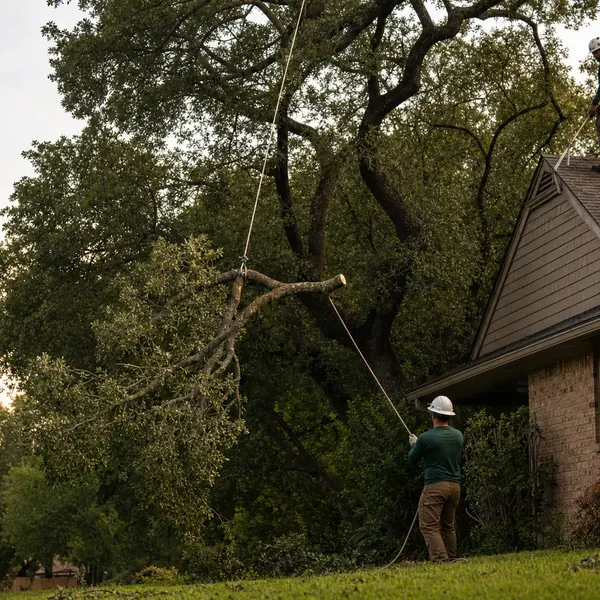
- Roping limbs over the roof and fence
- Brush chipped and hauled away


Crown reduction vs topping
A lot of people ask us to top a tree when what they really want is a smaller tree. Topping cuts the main limbs off at a set height, leaving stubs. The tree answers with a flush of thin, fast sprouts that are weakly attached, and the stubs rot. Within a few years the tree is taller again, uglier and more likely to break. We don’t do it.
Crown reduction gets you a smaller tree that still looks like itself. We shorten limbs by cutting each one back to a healthy side branch that’s big enough to take over as the new end. Mainstream pruning guidance suggests that side branch be at least a third the diameter of the limb being cut. The result is a tighter, lower canopy with no stubs and much less regrowth.
There are limits. Taking off too much leaf area at once can starve a tree, especially in a hot Plano summer, so we keep reductions moderate and sometimes spread them over two visits. Some species handle it better than others, and older trees need a lighter touch.
For live oaks and red oaks, we schedule reduction work outside of February through June when we can, following Texas A&M Forest Service (opens in a new tab) advice on oak wilt. Every crew is insured, and the plan and price are on paper before anyone climbs.
Reducing trees in Plano yards
A lot of Plano yards have big shade trees planted close to the house when the trees were small. Live oaks spread wide and low, red oaks and pecans get tall, and after a few decades the canopy is sitting over the roof. Crown reduction lets you keep that shade while pulling the tree back from the shingles and lowering the weight that hangs over the house in a storm.
Our summers are a big factor in how much we take. A tree uses its leaves to make food, and July and August heat already push it hard. That’s why we keep reductions modest and avoid heavy work during the hottest stretch. In clay soil that dries out, a tree that loses too much canopy at once has less to fall back on.
Oaks get special timing. Texas A&M Forest Service recommends avoiding oak pruning from February through June to limit oak wilt (opens in a new tab) spread, so we plan live oak and red oak reductions for late summer through winter whenever we can. Pecans and cedar elms are more flexible. If your HOA has rules about canopy over sidewalks or a neighbor’s yard, check with your HOA, and we’ll build the plan to fit.
Reduce it or remove it?
Reduction works on trees with strong side branches and good health. Some trees are poor candidates, and it’s better to know that before we start cutting.
Good candidate for reduction
- A healthy live oak spreading over the roof
- A tall pecan or red oak that’s heavy on one side
- Plenty of strong side branches to cut back to
- A tree you want to keep for its shade
- Limbs reaching over a neighbor’s yard or pool
Probably not worth reducing
- Thin, declining canopy with lots of deadwood
- A tree that was topped before and is full of stubs
- Decay in the main trunk or big limbs
- A species that breaks easily, like a Bradford pear
- A tree that would need to lose too much to fit the space
What affects the price of crown reduction
Crown reduction is careful, limb by limb work, and the price follows how much of the tree has to be worked.
- Tree height and spread. Bigger canopies mean more limbs to shorten and more time in the tree.
- How much reduction. A light pull back from the roof is less work than reducing the whole crown.
- What’s below. Limbs over the house, pool or fence have to be roped down piece by piece.
- Climbing access. Some trees can be worked from a lift. Others need a climber moving through the crown.
- Phased work. If we spread a reduction over two visits for the tree’s health, each visit is priced on its own.
- Brush volume. Reducing a large crown produces a lot of brush to chip and haul away.
The reduction plan and one written price come before anyone climbs. You’ll know which limbs shorten, how much, and what it costs, with no add-ons at the end.
What to expect on reduction day
- Walk the plan. We look at the tree with you and confirm the target size and the limbs that will shorten.
- Working from the outside in. The climber shortens limbs one at a time, cutting back to strong side branches.
- Roping over targets. Limbs above the roof or fence are tied off and lowered instead of dropped.
- Checking the shape. We step back as we go so the crown stays balanced and natural looking.
- Clean up. Brush is chipped and hauled, and the yard is raked and blown before we go.
How to get ready
- Decide what matters most, like roof clearance or a lighter crown
- Move cars out from under the canopy
- Clear patio furniture and grills from under the tree
- Keep pets inside during the work
- Let your neighbor know if limbs over their yard are being cut
Crown reduction questions
Is crown reduction bad for the tree?
Done properly and in moderation, it’s one of the better ways to manage a big tree. Problems come from removing too much at once or making stub cuts, which we avoid.
How much can you reduce a tree?
It depends on the species, age and health. Most reductions are modest. We set a size the tree can recover from and tell you before we start.
Why won’t you top my tree?
Topping causes rot, weak regrowth and a tree that’s more dangerous than before. Crown reduction gets you a smaller tree without those problems.
How long does a reduction last?
Usually several years, since proper cuts don’t trigger the burst of sprouts topping does. We can suggest when to check it again.
Will a reduced tree still give good shade?
Yes, just a little less of it. A moderate reduction keeps most of the leaf area, so the tree still shades the yard and stays healthy. The canopy will fill back in a bit over the next few seasons.
Can crown reduction help a tree near power lines?
Work right around energized lines belongs to the utility (opens in a new tab) and their line clearance crews. We can reduce limbs that are near, but not on, your service drop and talk with you about what to call the utility for.
Is crown reduction the same as thinning?
No. Thinning removes some branches all the way back to where they start, which opens the canopy but keeps the tree the same size. Reduction shortens limbs so the tree is actually smaller. Many jobs use a little of both.