
How to Prepare Your Trees for North Texas Storms
You can’t stop a storm, but you can lower the odds that a limb ends up on your roof. Most of the work happens on a calm day, well before the forecast turns.
Key takeaways
- Walk your trees before storm season and look for dead limbs, cracks and weak unions.
- Remove dead wood and reduce heavy limbs over the house, not the whole canopy.
- Cabling and bracing can support trees with weak unions.
- Don’t top trees or strip their interiors to storm-proof them. It backfires.
- After a storm, stay clear of downed lines and document damage before cleanup.
What North Texas storms do to trees
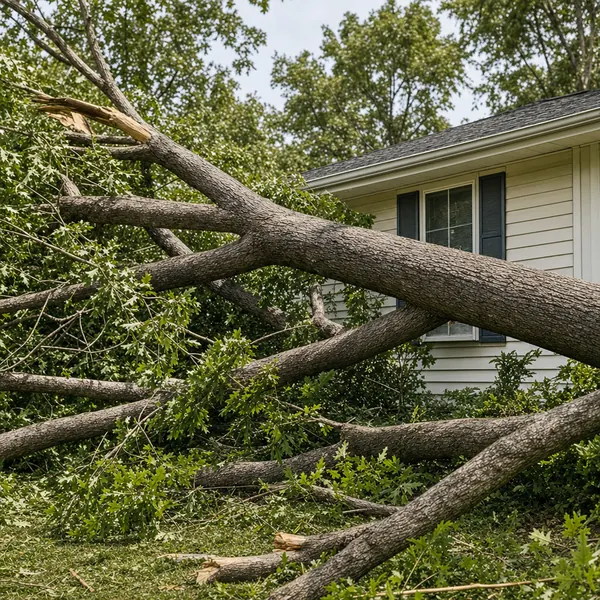
North Texas sees a mix of hard weather. Spring brings strong thunderstorms with straight-line winds and hail. Winter sometimes brings ice that loads every twig with extra weight. Long dry summers can leave trees stressed going into fall. Each of these finds a tree’s weak points.
Healthy, well-structured trees usually come through storms with minor damage. Trees with dead wood, decay, weak branch unions or heavy, overextended limbs are the ones that break. Some species are more prone to splitting than others. Bradford pears, for example, are well known for breaking apart at their tight, narrow forks.
Walk your trees before storm season
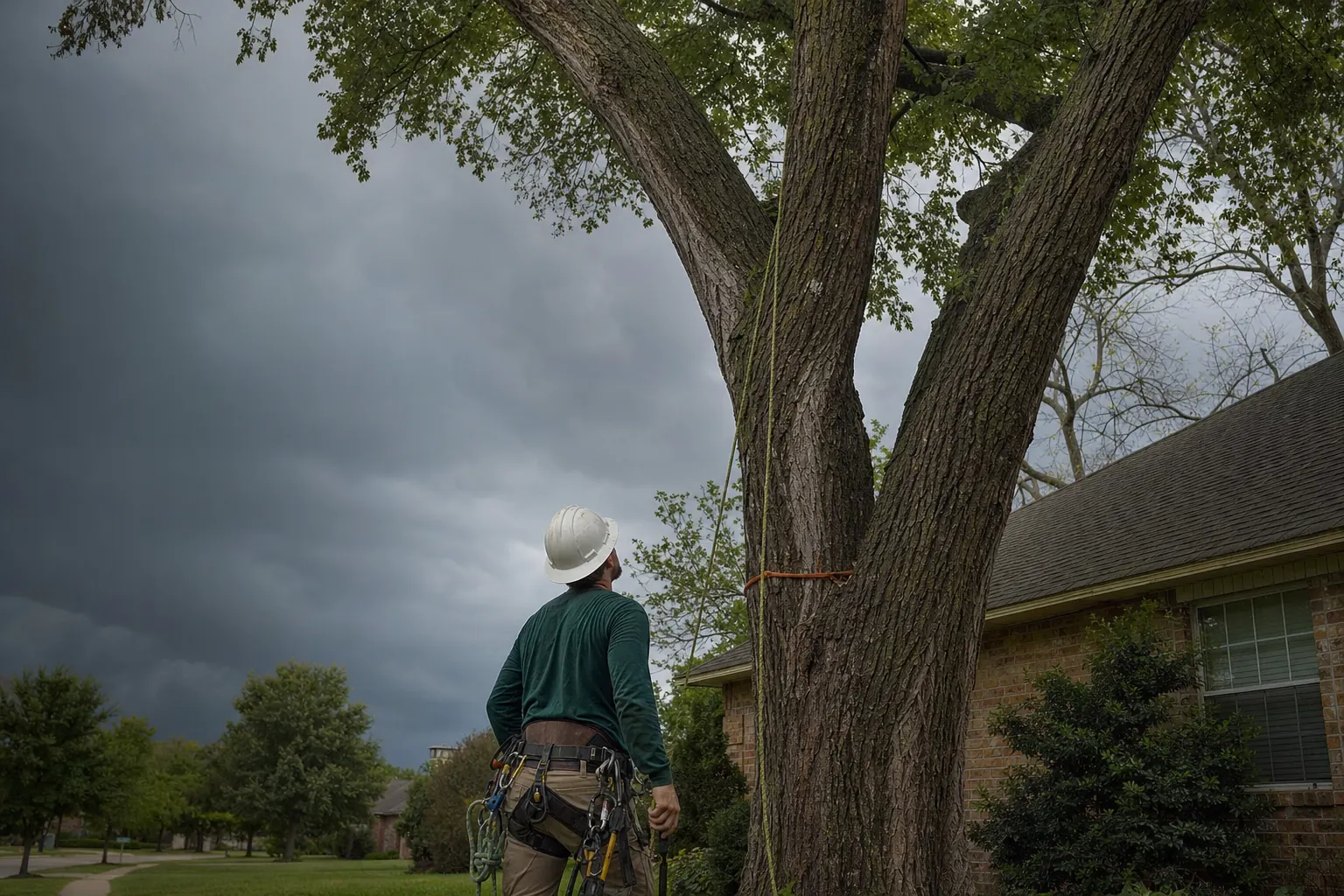
Late winter, before spring storms, is a good time for a slow look around your yard. You don’t need any tools. Look for these:
- Dead branches, especially large ones over the roof, driveway or play area.
- Cracks in the trunk or where major limbs attach.
- Two main trunks of similar size growing tightly together in a V, often with bark pinched between them.
- Long limbs reaching far out with most of the weight at the ends.
- Hanging or broken branches left over from the last storm.
- Mushrooms, conks or soft wood at the base, which can signal decay.
- A lean that has changed, or soil heaving on one side.
If you spot any of these on a tree that could hit the house, a car or a place people gather, it’s worth having an arborist look before the next storm rather than after.
Pruning that helps, and pruning that hurts
The right pruning reduces storm risk without weakening the tree. That usually means removing dead wood, shortening heavy limbs over targets by cutting back to healthy side branches, and correcting weak structure on young trees while the cuts are still small.
Some common storm-proofing ideas do more harm than good. Topping leaves the tree with fast, weakly attached regrowth that breaks more easily in later storms. Stripping out the inner branches and leaving tufts at the ends, often called lion-tailing, shifts weight to the tips and can make limbs more likely to snap. Heavy thinning all at once can stress the tree and expose it to more wind than it’s used to.
On oaks, timing matters too. Avoid routine pruning February through June because of oak wilt, and plan any storm prep work on oaks for the safer months. Paint every oak cut right away.
When cabling and bracing make sense
Some trees have a weak spot that’s worth supporting rather than cutting off. A large tree with two codominant trunks, for example, may be a candidate for cabling, where a flexible cable is installed high in the canopy to limit how far the stems can move apart. Bracing uses rods through weak unions or cracks for more rigid support.
Cabling and bracing don’t make a tree storm-proof, and they aren’t right for every tree. They work best on trees that are otherwise healthy, and the hardware needs to be checked periodically. An arborist can tell you whether support makes sense or whether the risk is too high to keep the tree.
Planting trees that hold up better
Storm prep also happens when you plant. Trees with strong wood and good natural structure tend to fare better in wind and ice than fast-growing, brittle ones. Native and well-adapted species like live oak, bur oak, chinquapin oak and cedar elm are widely recommended for North Texas yards.
Placement matters as much as species. Give large trees enough room from the house and overhead lines, and start structural pruning while they’re young. A few small cuts in the early years can prevent the weak forks that split in storms later.
During and after the storm
Once the weather turns, stay inside and stay away from windows facing large trees. After it passes, take a careful look before going near any damage.
- Stay well away from downed power lines and anything touching them. Call the utility.
- Don’t stand under hanging or cracked limbs.
- Take photos of damage before anything is moved, for your insurance company.
- Don’t climb or run a chainsaw on storm-damaged trees yourself. Broken wood is under tension and can move without warning.
- Check insurance and get a written price before hiring anyone, especially door-to-door crews.
If an oak is damaged in spring, have the broken limbs cleaned up and the wounds painted, even though it’s oak wilt season. A clean cut and a coat of paint is better than a ragged open wound.
If you’d like a tree looked at before storm season, or you’re dealing with damage now, give us a call. We offer priority scheduling after storms and we’ll put the price in writing. Call (214) 620-8082 or request a free written quote below.


Storm preparation questions
When should I get my trees checked before storms?
Late winter is a good time, before spring storm season starts. You can see branch structure clearly with the leaves off, and there’s time to schedule work.
Will thinning my tree make it safer in wind?
Light, selective pruning can help, especially removing dead wood and reducing heavy limbs. Heavy thinning or stripping the inside of the canopy can make things worse.
Can cabling prevent my tree from splitting?
Cabling can reduce the chance of a weak union splitting, but it doesn’t make a tree storm-proof. It works best on otherwise healthy trees and needs periodic checks.
Should I remove trees close to my house before storm season?
Not automatically. Many trees near houses are healthy and well-structured. An arborist can tell you whether pruning, support or removal is the right call.