
Signs Your Tree Is Dying
Trees rarely die overnight. Most give you signs months or years ahead, and catching them early is often the difference between saving a tree and removing it.
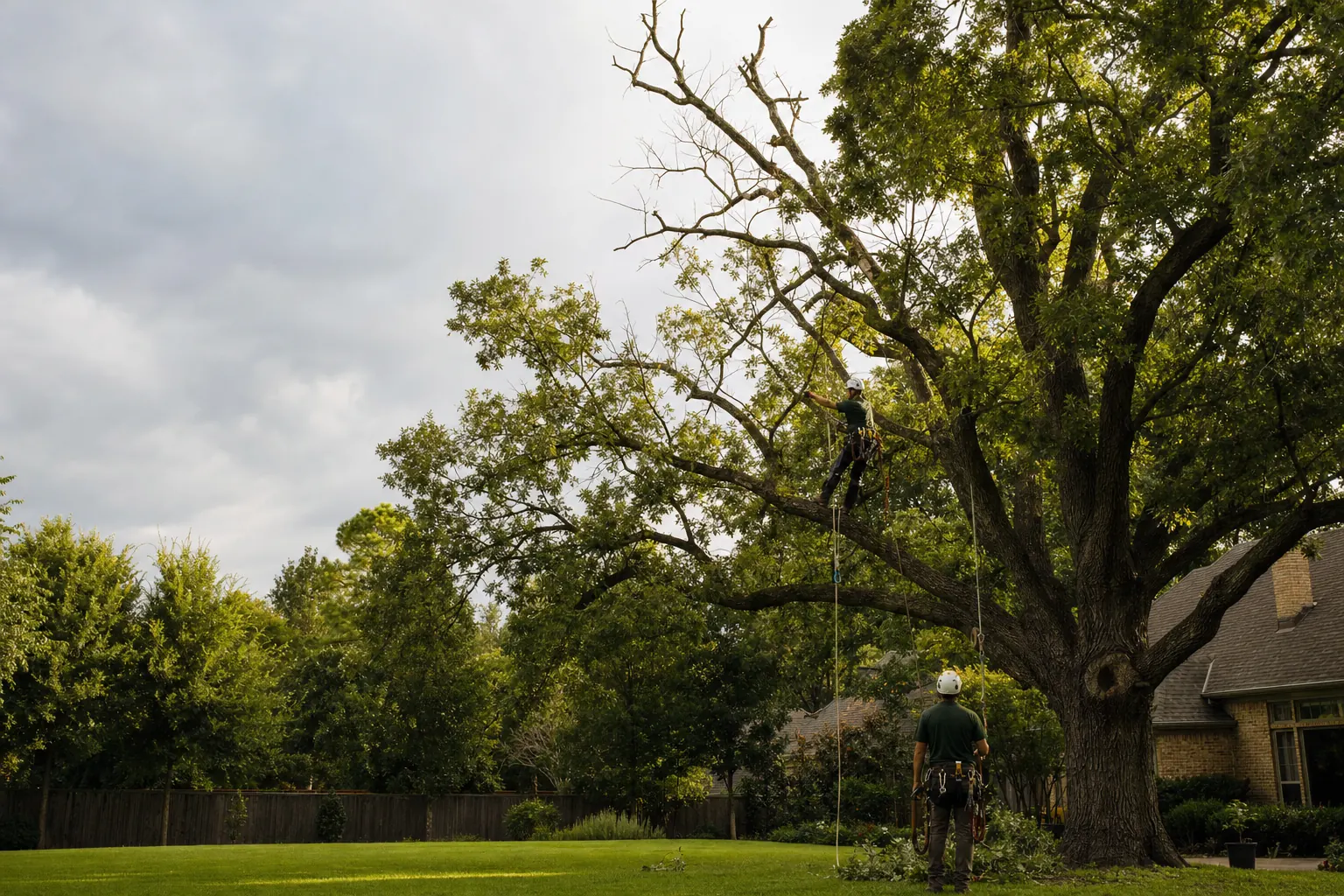
Key takeaways
- A thinning canopy and dead branches at the top are early warnings.
- Mushrooms or conks at the base can point to decay in the roots or trunk.
- New cracks, a sudden lean or lifting soil are urgent safety signs.
- A scratch test on a twig tells you if that part of the tree is still alive.
- Many stressed trees can recover with the right care, so get it checked before deciding.
Start with the canopy
The top of the tree usually shows trouble first. Stand back far enough to see the whole crown and compare it to how it looked a year or two ago. Photos help if you have them.
- Thin or sparse leaves compared with past years or with similar trees nearby.
- Dead branches in the upper canopy, sometimes called dieback.
- Small, pale or yellowing leaves during the growing season.
- Early fall color or leaf drop in mid to late summer.
- Leaves that wilt and stay wilted, or turn brown while still hanging on.
One or two dead branches aren’t cause for alarm. Every tree sheds some. A pattern of dieback that grows year over year is a different story.
Check the trunk and bark
Walk around the trunk slowly. The bark is the tree’s protective skin, and damage there often means damage underneath.
- Bark falling off in patches, with bare wood showing.
- Vertical cracks or splits in the trunk or major limbs.
- Cavities, soft spots or wood that crumbles when you press on it.
- Oozing sap or dark staining running down the bark.
- A dusty, gray to brown crust on the bark of a stressed oak or elm, which can be a sign of hypoxylon canker.
Look at the base and the roots
The root zone is where many serious problems hide, because you can’t see most of it. Watch for mushrooms or shelf-like conks growing at the base or on surface roots, which often mean decay inside. Look for soil that’s cracked or heaving on one side of the tree, roots that have been cut by trenching or construction, and soil piled up against the trunk.
Construction is a common cause of slow decline in North Texas neighborhoods. A new driveway, a pool, a sprinkler trench or a few inches of fill dirt can damage roots without anyone noticing. The tree may look fine for a year or more, then start thinning from the top.
The scratch test, and its limits
If you’re not sure whether a branch is alive, use your thumbnail or a pocketknife to scratch a small spot of bark on a twig. Green, moist tissue underneath means that part is alive. Brown and dry means it’s dead. Try a few spots in different parts of the tree, working from the tips toward the trunk.
The scratch test is handy, but it only tells you about the branch you scratched. A tree can have plenty of living twigs and still have serious decay in the trunk or roots. It also won’t tell you whether a living tree is safe. For that, you need someone who knows what to look for.
Common causes of decline in North Texas
Knowing the likely cause helps decide what to do. In this part of Texas, a handful of problems come up again and again.
- Drought and heat. Long, hot summers on clay soil can leave trees short on water for weeks. Stress builds up over several seasons, and dieback often shows a year or two after a bad summer.
- Root damage. Trenching, paving, grade changes and soil compaction from equipment all cut off roots a tree depends on.
- Planting too deep. A trunk that goes straight into the ground like a pole, with no visible flare at the base, may have been planted too deep or buried by mulch or soil.
- Disease. Oak wilt in live oaks and red oaks, and hypoxylon canker on trees that are already stressed, are two of the better known ones here.
- Storm injury. Broken limbs and torn bark open the door to decay that may not show for years.
What’s urgent and what can wait
Some signs mean the tree could be a safety problem soon. Call an arborist promptly if you see a new or worsening lean, especially with soil lifting on the opposite side, a large crack in the trunk, a big dead limb over the house, driveway or play area, or heavy decay at the base.
Other signs, like a thinning canopy or scattered dead branches, give you more time. Stressed trees can often recover with the right help: removing dead wood, correcting soil piled against the trunk, adding mulch, deep watering during drought and keeping construction out of the root zone. The cause matters, so it’s worth getting a proper look before you decide anything.
And if a tree is dead, it’s usually better to deal with it sooner than later. Dead wood gets more brittle with time, which makes the tree harder and riskier to take down safely.
If your tree is showing a few of these signs, we’ll come out, tell you what we see and whether it can be saved, and put any price in writing before work starts. Call (214) 620-8082 or request a free written quote below.
Related services


Dying tree questions
Can a dying tree be saved?
Sometimes. It depends on the cause and how far the decline has gone. Trees stressed by drought, soil problems or a few dead limbs often recover. Trees with major root or trunk decay usually don’t.
Are mushrooms at the base of a tree a bad sign?
Often, yes. Mushrooms and conks are the fruiting bodies of fungi, and some of those fungi decay wood. It’s worth having the tree checked.
How fast does a dead tree become dangerous?
It varies, but dead wood gets more brittle as it dries and decays. A dead tree near the house, driveway or a play area should be looked at soon.
My tree leafed out on only one side. What does that mean?
It can point to root damage, trunk damage or disease on that side. It’s a good reason to get an arborist to look at the tree.