
When to Trim Trees in North Texas
There’s no single best month for every tree. The right timing depends on what you’re growing and why you’re cutting, and for oaks, timing matters a lot.
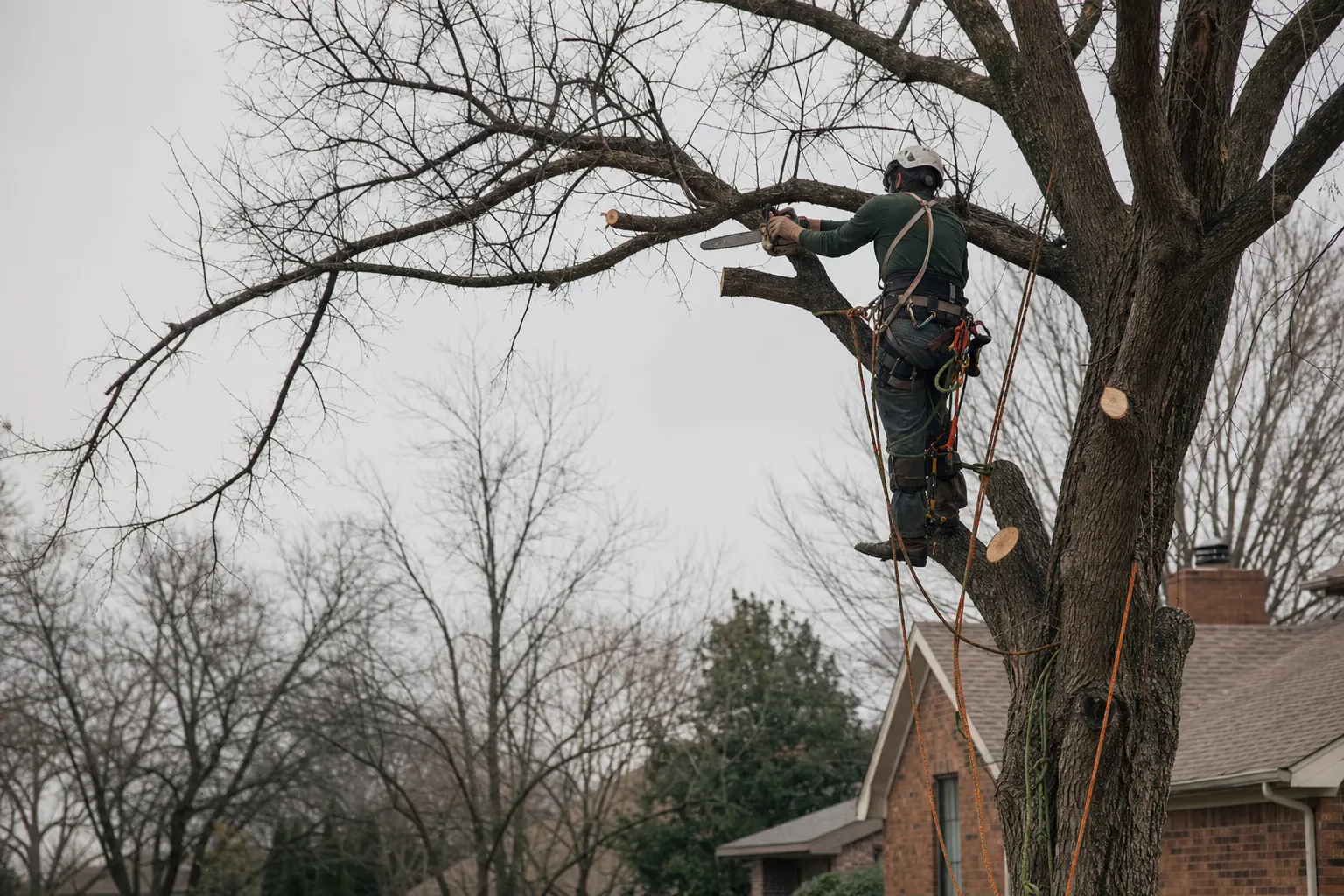
Key takeaways
- Late winter dormancy is a good default for most shade trees.
- Oaks are different in Texas: avoid pruning them February through June because of oak wilt.
- Spring-flowering trees are best pruned right after they bloom.
- Dead, broken or hanging limbs should come out whenever you find them.
- Light, regular pruning beats a big cut every few years.
The short answer for most shade trees
For many shade trees, the dormant season, from late fall through winter, is a good time to prune. The leaves are off, so it’s easy to see the branch structure. The tree isn’t pushing out new growth, so it isn’t spending energy that a cut would waste. And there are fewer insects and disease spores around to find fresh wounds.
Winter has a practical upside in North Texas too. Lawns and flower beds are mostly dormant, so foot traffic and dragged branches do less harm, and without leaves in the way it’s easier to see exactly which branches need to go and which should stay.
Cedar elms, lacebark elms, pecans and most other common North Texas shade trees do well with winter pruning. That said, light pruning can be done most of the year if it’s done well. Good cuts in the right places matter more than the exact week on the calendar.
Oaks follow their own calendar
If you have live oaks or red oaks, this is the part to remember. Texas A&M Forest Service advises avoiding oak pruning from February through June. That’s when oak wilt spreads most easily, because sap beetles that carry the fungus are drawn to fresh wounds.
The lower-risk windows are the coldest part of midwinter and the hottest part of midsummer. Whenever an oak is cut or wounded, the wound should be painted right away with wound paint or latex paint. That goes for storm breaks too. If a spring storm snaps an oak limb, have it cleaned up and painted rather than leaving a ragged break.
A rough guide by tree type
These are general patterns, not hard rules. Your tree’s health and the reason for the cut can change the plan.
- Live oaks and red oaks: July through January, painting every cut. Avoid February through June.
- Cedar elms and lacebark elms: dormant season is ideal. Light pruning is fine most other times.
- Pecans: winter dormancy works well and makes structure easy to see.
- Crape myrtles: late winter, with selective thinning rather than chopping the tops.
- Spring bloomers like Mexican plum and redbud: right after flowering, so you don’t cut off next year’s buds.
- Young trees of any kind: early structural pruning, a little at a time, sets them up for decades.
What shouldn’t wait for the right season
Some work is about safety, not timing. Don’t hold off on these just because it’s the wrong month:
- Dead branches over the roof, driveway, play area or sidewalk.
- Limbs that are cracked, split or hanging after a storm.
- Branches rubbing the roof or touching the house.
- Anything near a power line, which should be handled by the utility or a qualified line-clearance crew.
Dead wood doesn’t help the tree, and removing it is low-risk for the tree any time of year. On oaks, the cuts still get painted.
Signs a tree is due for trimming
Rather than trimming on a fixed schedule, it helps to look for reasons. Walk around your trees once or twice a year, ideally once in winter when branches are bare and once in summer when the canopy is full.
- Branches touching or hanging over the roof, gutters or chimney.
- Low limbs blocking the driveway, sidewalk or the view of the street.
- Dead or leafless branches mixed in with healthy ones.
- Branches crossing and rubbing against each other.
- A young tree growing two competing main stems that could split later.
- Long, heavy limbs reaching far out with most of the leaves at the very end.
If you see one or two of these, it’s usually a good time to plan a visit. Fixing small problems early is easier on the tree than catching up after years of neglect.
How much to take off
Timing gets a lot of attention, but the amount you remove matters just as much. Taking too much live canopy at once stresses the tree, invites sprouting and can leave it weaker than before. That’s especially true for big, mature trees, which handle heavy cuts worse than young ones.
A good pruning job removes what needs to go, like dead wood, crossing branches and limbs crowding the roof, and leaves the natural shape alone. Cuts are made just outside the branch collar, the slightly swollen ring where a branch meets the trunk, so the tree can seal the wound. Flush cuts, stubs and topping all cause problems that last for years.
In North Texas, it also helps to avoid heavy pruning during a hard drought or a stretch of extreme heat. A stressed tree has fewer reserves to recover, so a lighter touch or a short delay is often the smarter call.
Not sure whether your tree is due, or whether now is the right time? Tell us what you’re growing and we’ll give you a straight answer and a written quote. Call (214) 620-8082 or request a free written quote below.


Tree trimming timing questions
Can I trim my live oak in the spring?
It’s best not to. In Texas, the guidance is to avoid pruning oaks February through June because of oak wilt. If storm damage forces a cut, paint the wound right away.
Is summer a bad time to trim trees?
Not always. Midsummer is actually one of the lower-risk windows for oaks. For other trees, light pruning is fine, though heavy pruning during drought or extreme heat is best avoided.
How often should trees be trimmed?
It depends on the tree’s age, species and location. Young trees benefit from light structural pruning every few years. Mature trees usually need less, mostly dead wood and clearance.
Do I need to paint cuts on trees other than oaks?
Generally no. Most trees seal cuts on their own when the cut is made in the right place. Oaks are the exception in Texas because of oak wilt.