
Why Tree Topping Hurts Trees
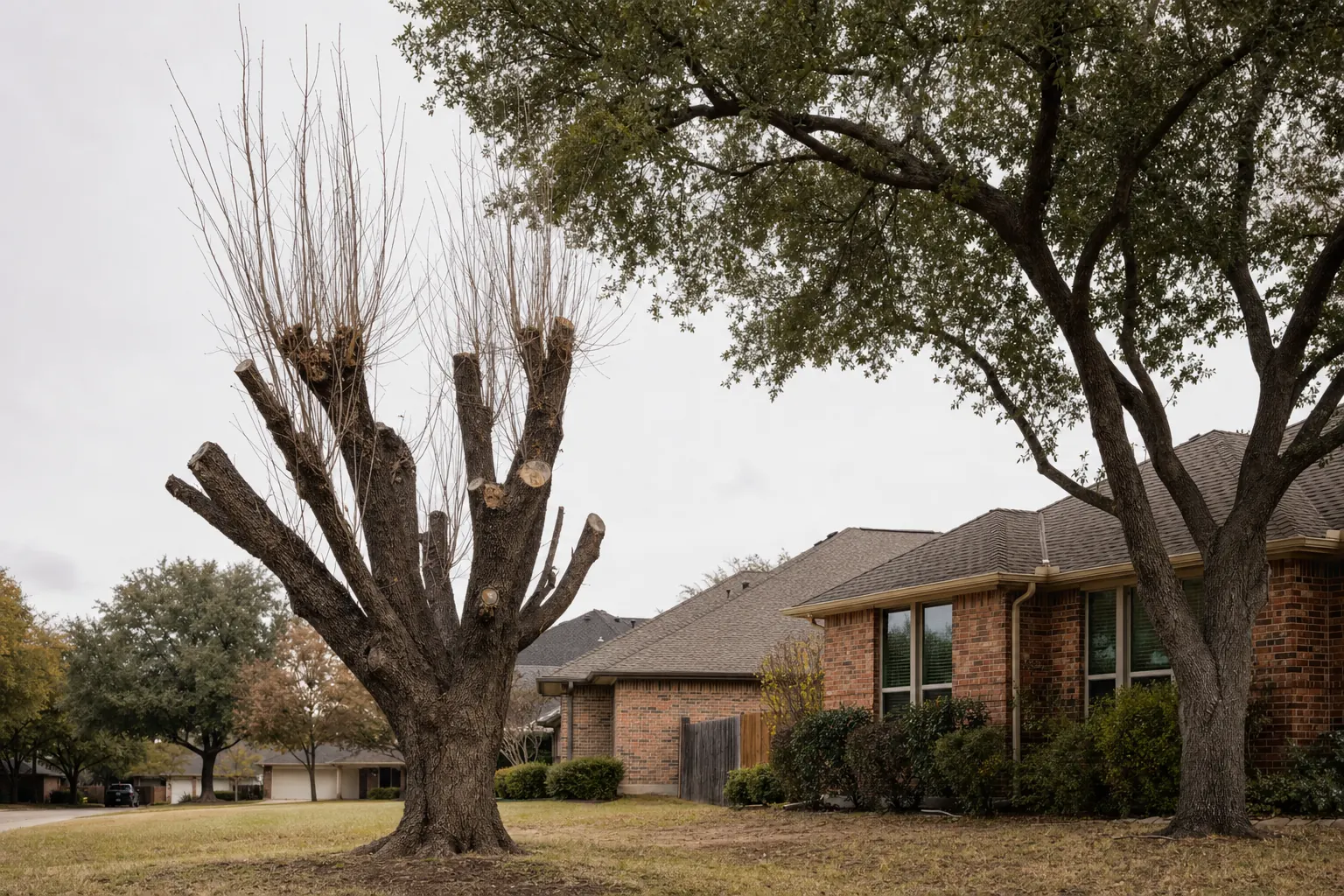
Topping is one of the most common ways trees get ruined. It looks tidy for a season, then leaves you with a weaker, riskier tree that needs more work, not less.
Key takeaways
- Topping cuts big branches back to stubs with no regard for the tree’s structure.
- The regrowth is fast, dense and weakly attached, so it breaks more easily.
- Large stub cuts invite decay that can spread into the trunk.
- Crown reduction makes a tree smaller the right way, by cutting back to healthy side branches.
What topping is
Topping means cutting the main branches of a tree back to stubs, usually to make the tree shorter. You’ll also hear it called heading, hat-racking or rounding over. The cuts are made wherever the crew decides the tree should stop, not at a natural branch point.
People usually ask for topping for understandable reasons. The tree feels too tall, it’s near the house, or a storm made them nervous. The trouble is that topping doesn’t solve those problems. In most cases it makes them worse a few years down the road. That’s why the International Society of Arboriculture and most trained arborists recommend against it.
What happens to a tree after it’s topped
A topped tree loses a big share of its leaves in one day, and leaves are how it makes food. The tree reacts in ways that are hard on it over time.
- It panics into growth. The tree pushes out a flush of fast, upright sprouts near each cut to replace lost leaves, using stored energy it would otherwise keep in reserve.
- The new growth is weakly attached. Those sprouts grow from the outer layers of wood instead of from a strong branch union, so they break off more easily in wind and ice.
- Stubs decay. A big cut with no side branch nearby can’t seal well. Decay can move from the stub down into the limb and sometimes into the trunk.
- Bark gets exposed. With the canopy suddenly gone, bark that was shaded can be damaged by hot North Texas sun.
- It grows back taller, fast. Many topped trees return to their old height within a few years, now with a crowded, weak canopy on top of decaying stubs.
Why it costs you more over time
A topped tree is a maintenance tree. The sprouts need to be thinned again and again, and the decaying stubs often need attention as they weaken. Instead of one careful pruning every few years, you end up with repeated work on a tree that’s getting less sound each time.
There’s also the safety side. Weakly attached sprouts sitting on decayed stubs are exactly the kind of limbs that fail in a North Texas spring storm. And on some species, a heavy topping is enough to start a decline the tree never recovers from. A tree that was worth keeping can become a tree that has to come down.
Then there’s the look. A topped tree loses its natural shape, and it rarely gets it back.
What to do instead
If a tree is too big for its space, there are better options. The right one depends on the species, the tree’s health and what you’re trying to fix.
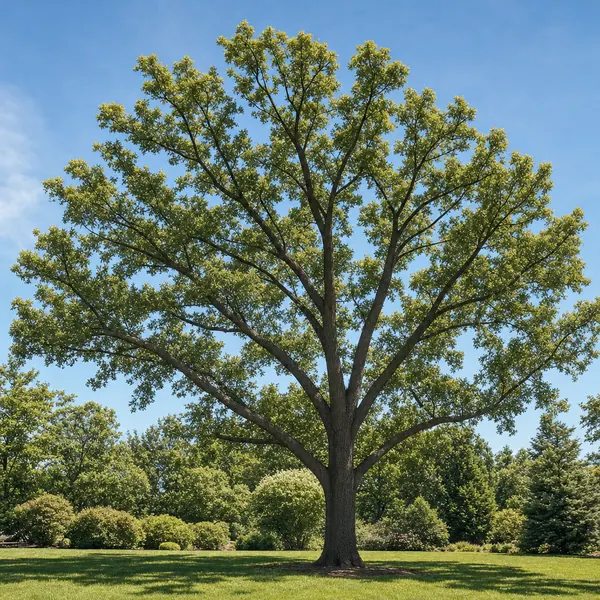
- Crown reduction. Branches are cut back to a healthy side branch that’s big enough to take over as the new end. The tree gets smaller and keeps its natural shape.
- Clearance pruning. Limbs over the roof, driveway or sidewalk are shortened or removed selectively.
- Selective thinning. A few interior branches are removed to reduce weight on long limbs, without stripping the inside of the canopy.
- Cabling and bracing. For trees with weak unions or heavy limbs, hardware can add support while keeping the tree.
- Removal and replanting. Sometimes the honest answer is that the tree is the wrong tree for the spot. Replacing it with a species that fits is better than topping it every few years.
How to tell if a crew plans to top your tree
Topping usually isn’t called topping on a quote. Listen for phrases like taking the tree down by a third, cutting it back to the main branches, or making it round and even. Ask how the crew decides where each cut goes. A trained arborist will talk about cutting back to side branches, keeping the natural shape and taking only what’s needed.
It’s also fair to ask whether an ISA Certified Arborist will look at the tree, and to get the plan in writing. If the answer to a tall tree is always to cut the top off, that’s a good sign to get another opinion.
If your tree has already been topped
It’s not always a lost cause. An arborist can help a topped tree rebuild structure over several years by choosing the strongest sprouts at each cut, thinning the rest and slowly letting a new framework develop. It takes patience and a few visits, but some trees come back surprisingly well. Others are too decayed to be worth the effort, and an honest assessment will tell you which you have.
We won’t top your tree. If it’s too big for its space, we’ll walk you through the options that keep it healthy, and give you the price in writing. Call (214) 620-8082 or request a free written quote below.


Tree topping questions
Is topping ever okay?
Most arborists avoid it on shade trees. In rare cases, like certain utility or emergency situations, heavy cuts happen, but it isn’t a good way to manage a healthy tree.
Is crown reduction the same as topping?
No. Crown reduction cuts back to a healthy side branch that can take over, which keeps the tree’s structure. Topping cuts to stubs wherever the crew decides.
What about crape myrtles?
Chopping crape myrtles back to the same knuckles every year is a form of topping. Selective thinning in late winter keeps them healthier and better looking.
Can a topped tree recover?
Some can, with structural pruning over several years. A tree with heavy decay at the cuts may not be worth saving.