
Hackberry Trees in North Texas Yards: Keep It or Remove It?
Plenty of North Texas homeowners never planted their hackberry. It showed up along the fence, grew fast and one day it was shading half the yard. Some of those trees are worth keeping. Some are trouble waiting for a windy day.
Key takeaways
- Hackberries are native trees that birds plant for free, which is why so many grow along fences and beds.
- Their wood is generally on the weak side, and they’re prone to decay, so big limbs can fail as the tree ages.
- Nipple galls, sticky leaves with sooty mold and lots of seedlings are common, and are usually more nuisance than threat.
- A healthy hackberry with good structure, in a spot with room to grow, can be a fine shade tree.
- Volunteers jammed against a fence, foundation or another tree, or older trees with decay, are often better removed.
Why hackberries show up on their own
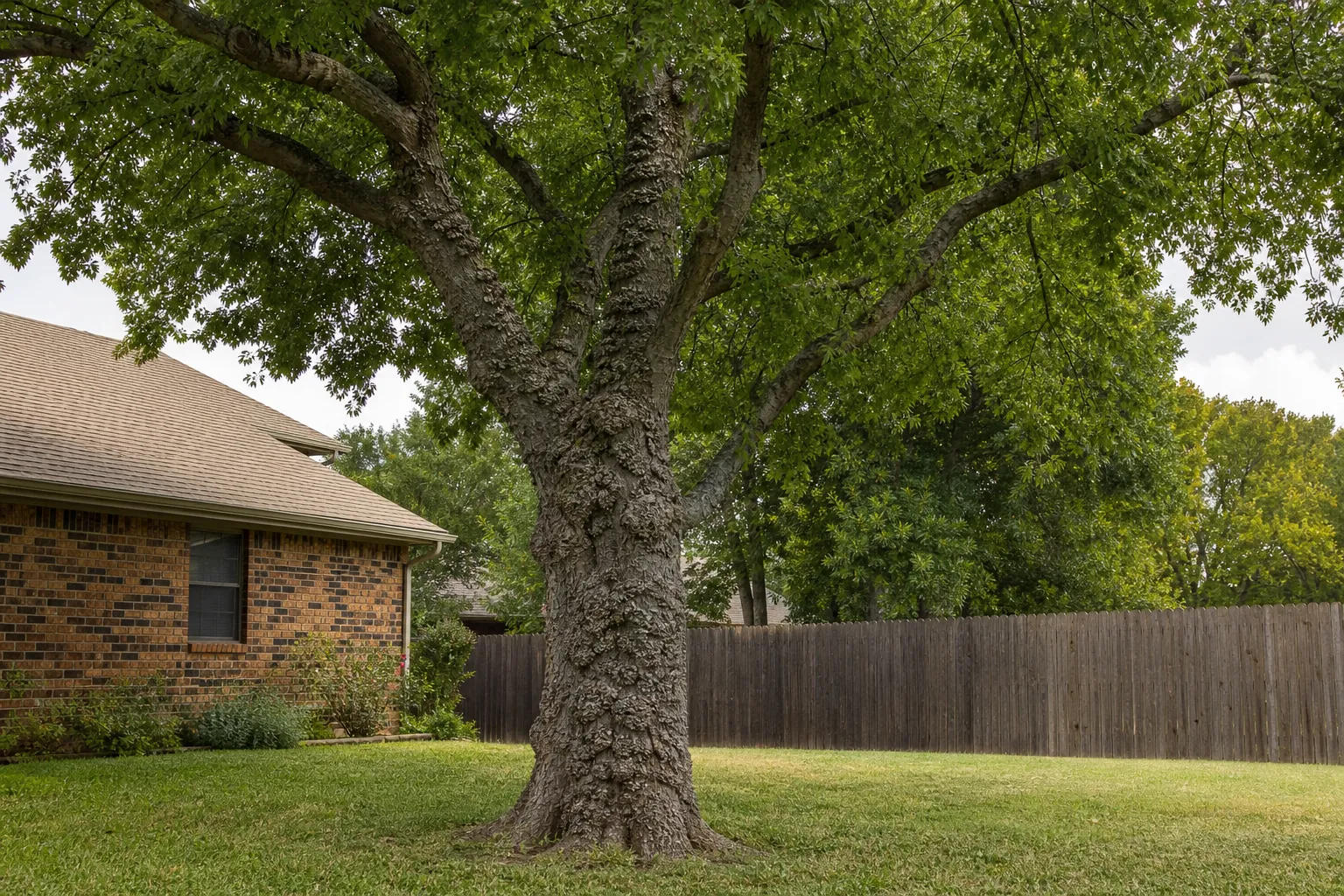
Hackberries are native across much of Texas and the central U.S. You’ll know one by its bark: gray, with corky warts and ridges that feel almost like they were glued on. The leaves are lopsided at the base and rough on top. In fall the tree carries small dark berries.
Birds love those berries. They eat them, perch on your fence or power line and drop the seeds below. That’s why hackberries so often come up in a straight row along a fence line, in the middle of a shrub bed or right next to the house. Nobody chose the spot. A bird did.
They grow quickly and they put up with heat, drought and heavy clay soil, so a seedling that nobody pulls can turn into a real tree in a surprisingly short time.
The weak-wood problem
The trouble with fast growth is that the wood is usually lighter and weaker. Hackberry is generally considered a weak-wooded tree, and it’s prone to decay once it’s wounded. A broken limb or an old pruning stub can let rot into the branch or trunk, and hackberry doesn’t seal off decay as well as tougher trees do.
Volunteer trees also tend to grow with poor structure. With nobody training them, they often end up with several trunks, tight forks and long limbs reaching for light. Put weak wood and weak forks together and you get a tree that sheds limbs in storms and, over time, can fail in bigger pieces.
That doesn’t mean every hackberry is dangerous. It means an older one deserves a closer look than, say, a sound live oak, especially if it leans over the house, the driveway or a neighbor’s yard.
Galls, sticky leaves and seedlings
Hackberries come with a few common nuisances. Most are cosmetic, but they’re a big part of why people ask about removing them.
- Nipple galls. Small bumps on the undersides of the leaves are very common on hackberry. They’re generally caused by tiny insects and are usually considered cosmetic, not a threat to the tree.
- Sticky leaves and sooty mold. Some sap-feeding insects drop a sticky residue, often called honeydew, on leaves, cars and patio furniture below. A black, sooty mold can grow on that residue. It’s messy, but it usually doesn’t harm the tree much on its own.
- Seedlings everywhere. Every berry season brings new sprouts in beds and along fences. Pull them while they’re small. Once the roots take hold in clay, they’re much harder to get out.
- Witches’ brooms. Dense clusters of twigs in the crown are common on hackberry and are generally cosmetic.
If a hackberry seems to be going downhill fast, with lots of dieback or bare limbs, something more than these nuisances may be going on. Our guide to signs your tree is dying covers what to look for.
When a hackberry is worth keeping
A good hackberry can give a lot of shade in a hard climate, and it feeds birds and wildlife. In most cases, it’s worth keeping when:
- It has one main trunk, or a few that meet at wide, sound unions.
- There’s no sign of decay: no mushrooms, cavities, soft wood or large dead limbs.
- It has room to grow and isn’t pressed against the house, the fence or another tree.
- It shades something you value without hanging heavy limbs over the roof.
A tree like that usually just needs good trimming every few years to remove dead wood and weak limbs and keep the crown balanced. That care matters more for hackberry than for stronger trees, because it cuts down on the broken limbs that let decay in.
When to remove one
Removing a hackberry is often the better call when:
- It came up against the fence, foundation, driveway or another tree and is already pushing on it.
- There’s decay, a cavity or fungus on the trunk or at a main fork.
- It has several trunks splitting apart or a crack at a fork.
- Big limbs are dying back or it keeps dropping branches.
- It’s crowding out a tree you’d rather keep, like an oak or a cedar elm.
Young volunteers are the easy case. The sooner a hackberry that’s in the wrong place comes out, the smaller and simpler the job. Waiting just lets it get bigger, and closer to whatever it’s growing against.
If you’re thinking about replacing it, ask a local nursery or landscaper about a stronger, longer-lived tree for that spot. Eagle doesn’t plant trees, but our guide to the best trees to plant in Plano gives you a starting list. For a tree that’s simply outgrown its space, see tree too big for your yard.
Not sure if your hackberry is a keeper? We’ll look at the trunk, the forks and where it sits, then tell you plainly and put the price in writing. Most removals are assessed by Taylor Guynes, an independent ISA Certified Arborist #TX-4334A (opens in a new tab). Call (214) 620-8082 or request a free written quote below.


Questions about hackberry trees
What is a hackberry tree?
Hackberry is a native deciduous tree found across much of Texas and the central U.S. It’s known for gray bark with corky warts and ridges, lopsided rough leaves and small dark berries that birds eat. Several closely related species are called hackberry or sugarberry.
How quickly do hackberry trees grow?
Generally fast, especially when young and in a sunny spot. That quick growth is why a volunteer along the fence can become a large tree before anyone decides whether they want it there, and it’s part of why the wood tends to be weaker.
Is a hackberry invasive?
Hackberry is native to Texas, so it isn’t considered an invasive species here. It can act weedy, though, because birds spread the seeds and seedlings come up all over beds and fence lines.
What are the downsides of having a hackberry tree?
The main ones are generally weak wood that can break in storms, a tendency to decay, poor structure on volunteer trees, sticky leaves and sooty mold from insects, leaf galls and lots of seedlings to pull. A healthy, well-placed tree can still be a good shade tree.